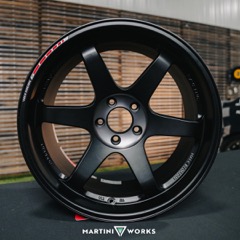
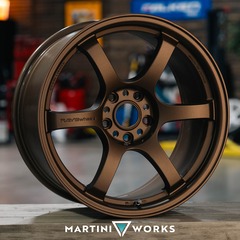
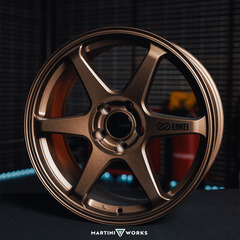
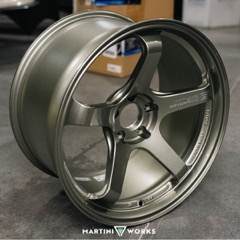
September 10, 2026 By alex martinez
Hayashi Racing, WORK Wheels, and Rays were all founded in the same Osaka suburb: Higashiosaka over 50 years ago. From stories that started racing teams, to wheels that were molded through sand just because there was no other way to do it, the history behind these wheel companies is properly impressive.
Most of what you'll read here isn't available in English. A lot of it came from conversations while AlexMartini was in Osaka, from people who worked at these companies decades ago, and from Japanese-language sources that never got translated.
Since that trip in 2025, the wheel community has continued to pass around half-truths and forum lore for years. This is our attempt to set the record straight on what actually happened, who did what first, and why Japanese wheel manufacturing earned its reputation.
Higashiosaka is an industrial suburb known for two things: rugby and small factories. Thousands of little workshops making bolts, screws, and stamped parts. Nothing glamorous. But in the 1960s, a shop called Hayashi Car Shop operated there, and the guy running it would accidentally start an entire industry.
The name is Masakazu Hayashi. Third generation of a family celluloid processing business. His dad and grandfather made plastics, but Masakazu wanted to do car stuff instead. He began building cars in his spare time and quickly found a need for new wheels that could be wider and more specific for his cars. The result? A Lotus 7 style piece built out of a Morris Minor.

At 27, Hayashi built a car called the Carmen Apache (a Honda 1300) and ran it at the 1969 Japanese Grand Prix at Fuji against factory teams and Nissan's V12 R382 prototypes. His homemade car placed 5th at a Suzuka race a few months later. But the thing people noticed wasn't the car. It was the race wheel he'd made for the Apache, because he was also running the same wheel on his street cars. People wanted them.

Everything else in the aftermarket wheel world pretty much starts here.
There's lore that Takeshi Tanaka (founder of WORK Wheels) was a Hayashi Racing employee. That's unconfirmed, but the connections between Hayashi and the brands that followed are hard to ignore. Multiple sources from under the highway bridges of Osaka point to Hayashi's shop as the training ground for the people who built the next generation of wheel companies.
Hayashi's cousin Minoru idolized him and wanted to follow in his footsteps. In 1975, Minoru founded his own company to build sports cars. The name? Dome. Yes, that Dome. The relationship between those two is what developed Hayashi's 712 Formula Car, and from there, the demand built the wheel dynasty of Japan.

Hayashi would go on to build the largest race car factory in Japan. His wheel shop in Higashiosaka outbuilt every constructor in the country. And the people who worked there went on to start their own brands.
Endless Brakes?
Started at Hayashi Racing.
Volk Racing?
Started at Hayashi Racing.
And WORK Wheels likely did too.
Hayashi wasn't the only one building in Osaka. In 1971, SSR was making waves well before the WORK Equip 01 came into the picture.
SSR wanted wheels that could be replaced in pieces instead of thrown away whole, keeping things more affordable. They came to market with the MK-1 in 1971: the first three-piece wheel. That beat BBS supplying their version to racing teams by one year.

Here's the myth: People ask all the time if Japan invented the three-piece wheel. The answer is no. Jim Hall's Chaparral program in the 1960s is where the concept originated according to OLD paperbooks. But there was never any IP protection around it, which is why everyone took the idea and claimed it as their own. Remember, the 70's didn't have the internet.
But the timeline gets messy. SSR was making three-piece wheels for racing in 1971. Weds claims to be the first three-piece forged wheel in 1977 and the BBS RS launched for the public market in 1983.
You can probably see why everyone argues about who was first. The answer depends on which qualifier you add to the question.

With so many brands popping up and copying each other, sand-casting was a sensitive manufacturing process (weak as hell if done wrong). So, SSR lobbied for Japan to do something about rising counterfeits. The result is that little stamp you see on almost every aftermarket wheel: the JWL standard.
The JWL became a way to regulate and endurance-test wheels within Japan. In 1981, the VIA was created to verify the testing.
But like all things; once Japan establishes something, they hardly have a way to enforce it globally. Since JWL is self-certified, Anyone can stamp it. And since VIA is an independent audit, that's also not independently verified. So the stamp only means something if the wheel company can source its testing documentation on its website. Keep that in mind next time you see "JWL" on a budget wheel from an unknown brand.

SSR took racing to a near-global level with the F2000, and the driver was someone you probably already know: Kunimitsu Takahashi, the father of drifting. Takahashi became SSR's poster boy and paired up with Keiichi Tsuchiya (who you definitely know) and Ryo Michigami (who you might not). Michigami won Super GT in 2018, still sponsored by SSR Racing.

Adrian Newey's F1 car? SSR wheels. But their most popular wheel wasn't even theirs. A lot of people think the Longchamp XR-4 was an SSR wheel. It wasn't. The XR-4 was iconic for Kaido racers and every Kenmeri Skyline in Japan, but it was made by Suzuka Sangyo, a completely different company. That's one of those myths that's been repeated so many times it became accepted fact.

SSR was also the first brand to use semi-solid forging, tested in a wheel called the Type-C, five years before Tanabe acquired the company.
Hayashi and SSR are what launched WORK in 1977. Rays incorporated the same year. BBS didn't join Japan's game until six years later.
What WORK did that nobody else did was sell to US customers faster than anyone. Six years after they started, they were shipping to America and pushing on-demand production, something Toyota had already proved was the best way to build cars. A lot of early WORK Wheels didn't come with center caps because the wheels were perceived as racing products. You don't use center caps on race cars because the plastic melts but personally, I just think it was to save money.
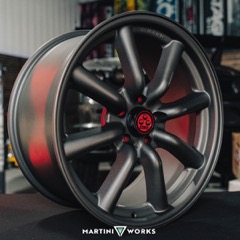
Founded in 1950 as Enshu Keigokin, Enkei was the first aluminum wheel manufacturer in Japan. Their goal from day one was to export everything for the booming car market. They are the oldest name on this list by a wide margin.
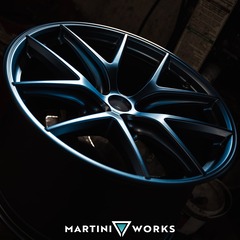
What Enkei did with McLaren from 1995 to 2021 was the foundation for their most famous street wheel. They made forged magnesium wheels for McLaren's F1 cars and used that program to launch the RPF1 in 2002. The RPF1 wasn't a vague "nod" to F1. It was directly modeled off the ES-071 that was on the McLaren MP4-22, the car Lewis Hamilton and Fernando Alonso raced in 2007. The design is called "Stress Dispersion," and it's why the RPF1 is still one of the lightest production wheels you can buy at its price point.
Masumi Shiba built Rays with the idea that the brand should be for the "people," which is why the sub-brand is called Volk (the German word for "people"). The same story played out here as with SSR: push insanely weird F1-grade designs into street wheels.
Early examples like the Volk Mesh weighed only 5kg in a 14x6 size. The C1 had a carbon fiber face on a road wheel. But the story that matters most involves one of the greatest race cars ever built: the Mazda 787B. The wheels on that car were Rays-supplied forged magnesium centers, 18x12 fronts and 18x14.75 rears.

That moment was so significant for the brand that they knew they had to push something to the public market. In 1996, the Touring Evolution (TE37) launched at 3.7kg. This was the first time you could see a wheel in something like N1 Taikyu endurance racing and then buy that same motorsport wheel for your own car. Within 36 months, the TE37 was the default wheel for pretty much everything in the Japanese performance scene.
The bronze finish exists partly because an unpainted satin surface saves weight. And Keiichi Tsuchiya (the same guy who put SSR on the map) set a Tsukuba record in the ARTA NSX on TE37 MAGs. The wheel world is small.

If you're a wheel nerd, you're probably wondering why Watanabe hasn't gotten more attention here. They deserve it. But like most histories, the story follows scale, and Watanabe stayed niche. They're the fax machine in the world of email now. We love Watanabe, but their story is one for a dedicated deep dive. Come back in a few weeks and I promise to spend more time here <3
Almost everyone in the wheel industry recognizes Japanese manufacturing as the best quality you can get. It outperforms Chinese, German, Taiwanese, American, and Mexican manufacturing because of the attention to detail baked into the process.
This is true even amongst the suppliers. After all, BBS motorsport multipiece wheels are Japanese. It's located in Takaoka, Toyama, operated by a company called Washi Beam. They've produced more than 24,000 Formula 1 wheels that raced under the BBS name. When the best German wheel brand outsources its forging to Japan, that tells you everything you need to know about where the real expertise lives.
You don't need to know any of this to buy a good set of wheels. But when you go to build your car, you should care about what you put on it. The wheels don't need to be the most expensive option. They should be something you're proud of. And knowing the history behind what you're buying makes the choice a lot more meaningful.
We stock WORK, Gram Lights, Advan, Volk Racing, Enkei, Watanabe, and more so you don't have to wait a year to get your dream set. Wheel and tire packages ship to your garage, ready to bolt on.
My name is Alex, or Alex Martini (Alex.Martini__) and I love building unreliable cars. From track, road, drag and drift, there really isn't a motorsport I love. PS if you're reading this, just know that we've got some WILD builds coming for MartiniWorks that we're really excited to share with you :)

Browse wheels by spoke style with the MartiniWorks Wheel Design Filter. Find five spoke, six spoke, multi spoke, mesh, windowed spoke, and split spoke designs that match your build.
Read Guide
Find the perfect aftermarket wheels that actually work for YOUR car and budget. Skip the confusion with our expert guide to wheel fitment, tier pricing, and the brands that matter most.
Read Guide