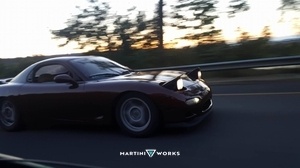
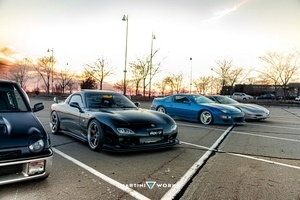
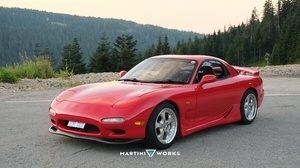
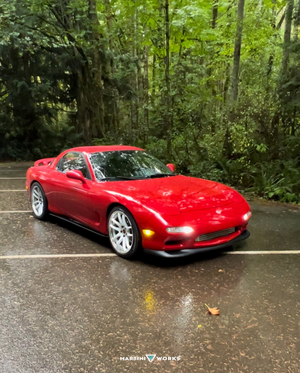
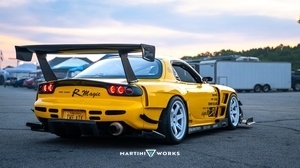
Hey everyone, introducing my 1993 Mazda RX-7 Touring project. I bought this car when I was 18 years old after searching for over a year, eventually tracking it down through an old newspaper ad. Back then, it was a completely stock 5-speed. Over the last 22 years of owning and modifying this chassis, the car has truly evolved with me as I matured in life. It's gone from completely stock, to modified twins, to a built streetported single turbo, and finally to my end all dream setup (3 rotor was always the goal, but I never knew how to get to it). Throughout the years of turning wrenches, I actually learned how to do almost all the mechanical work on this car myself—including building the motors. The only exceptions on this current iteration are that I didn't personally build this specific 20B short block, and I still don't know how to tune an ECU myself, so I’ll be leaving the calibration to a professional.
This project is my take on how Mazda would build an FD to compete in the current day while staying true to their original philosophy of "Back to basics" and being "Lightning in a world of thunder." The goal was to have a completely cohesive build inside and out.
The Setup Architecture & Short Block
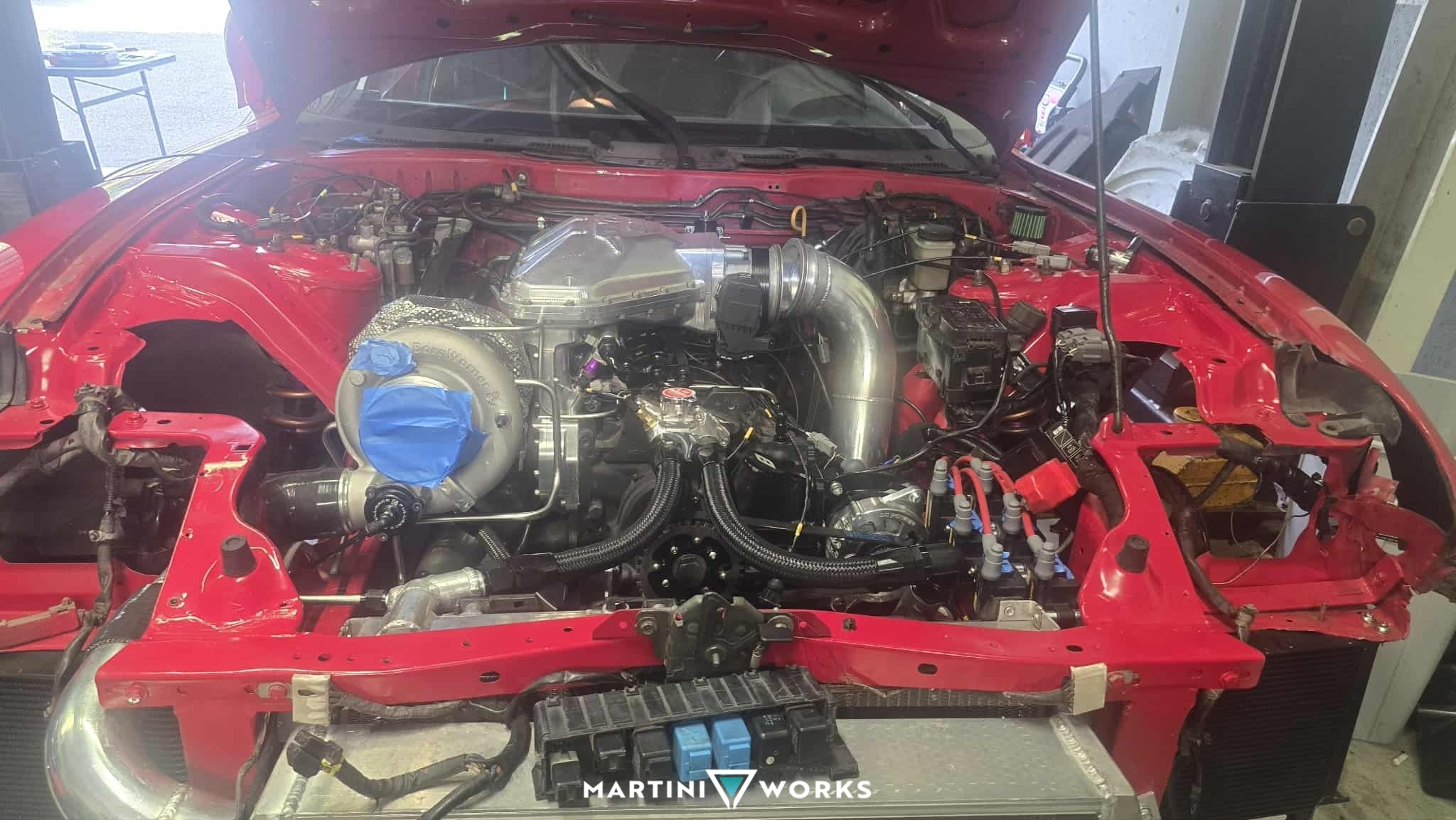
The core of the build is a 3-rotor 20B engine utilizing factory iron plates for now. The block is street-ported with clearanced and scalloped rotors for modified port timing, pinned with extra dowels, and built using RX Parts 2mm steel apex seals with fresh OEM corner seals and springs. To correct the nose-heavy weight bias that usually ruins a 3-rotor swap, the entire motor was pushed back 4 inches and dropped 1 to 2 inches lower in the subframe to centralize the mass.
Forced Induction, Intake, & Airflow
For the turbo setup, I am running a standard BorgWarner EFR 9280 utilizing an aluminum CHRA and the integrated blow-off valve, mated to an investment-cast stainless steel TiAL 1.45 A/R V-band turbine housing. This sits on a custom manifold breathing into a full 4-inch resonated titanium straight-through exhaust system that weighs exactly 21 pounds. For the intake track, I went with a Projay Bully manifold featuring symmetric runners, fed by a 90mm drive-by-wire Hellcat throttle body. Cooling is handled by a massive 5-inch Garrett intercooler core, Koyo N-Flow radiator, dual 25-row oil coolers with flush-fitting bumper ducts, and an adjustable Mazdaspeed aluminum under-tray.
Fuel System, Custom Harness & Multi-Stage Injection
To meet the massive fuel demands under boost, the engine is fitted with Injector Dynamics ID2000 primaries and massive ID2600 secondaries. Feeding those big boy sticks is a full Radium Engineering Multi-Pump Fuel Surge Tank system equipped with dual internally staged Hellcat fuel pumps, while an Aeromotive 340lph fuel pump acts as the primary feed from the main fuel tank.
Everything is controlled by a Haltech Elite 2500 ECU mapped to an incredible custom engine wiring harness from LMS-EFI. The harness is a full motorsport-grade milspec layout utilizing quick-disconnect circular bulkhead connections at the firewall to make future engine removals completely seamless. The high-output Haltech smart coils are relocated down low on the frame rail to keep the bay clean, and I've integrated a Davie Craig electric water pump completely controlled by the Haltech for precise temperature management.
To run 35 PSI safely on the street, I engineered a dual-stage water/methanol injection setup. Stage one is a progressive mechanical Wannaspeed injection kit spraying a Boost Juice mix pre-turbo at 10+ PSI to lower compressor discharge temperatures. Stage two uses secondary electronic nozzles controlled by the Haltech, positioned post-intercooler right up against the 90mm DBW plate for direct cylinder cooling. The ECU runs full 3D safety overrides for individual cylinder EGT spikes, fuel pressure drops, and oil pressure limits relative to RPM.
Drivetrain, Suspension, & Footwork
To handle the power, I swapped in a rugged Nissan CD00A 6-speed manual transmission adapted via a Fisch Racing Products Conversion Kit and a custom single-mass chromoly flywheel. Shifting is handled by a Serial Nine CD999 Technical Shifter Assembly paired with a custom titanium weighted shift knob for a short, mechanical throw. The rear end is a Ford Explorer 8.8 IRS rear differential mounted inside a structural Ronin subframe cradle and fitted with a Wavetrac LSD and 3.55 final. For footwork, I am running aluminum-body Quantum Racing coilovers with Swift springs at 10k front and 8k rear spring rates. These aluminum coilovers drop roughly 16 pounds of unsprung mass off the corners compared to the original factory steel shocks and bulky OEM springs. Braking is handled by a custom Ceika Big Brake Kit utilizing 6-piston front and 4-piston rear calipers over 330mm two-piece rotors. The car sits on multi-piece Fikse FC305 wheels wrapped in Toyo R888R competition tires, running 255/35/18 in the front and 295/30/18 in the rear.
Interior, Aesthetics, & Carbon Upgrades
Inside, the cabin features ultra-lightweight, fixed-back Tillett B5 carbon/FRP seats. These seats weigh just 8 pounds each, stripping a massive 60 pounds out of the interior compared to the heavy, bulky 38-lb factory leather units. They are bolted straight to the floor rails for direct chassis feedback. To bring the cohesive theme inside, the factory weighted emergency brake handle has been replaced with a matching titanium unit, and all of the interior "plastics" have been converted to dry carbon fiber to scale up the cabin texture while completely eliminating dashboard glare.
The main cluster features custom Speedhut gauges in the classic layout with a prominent red 10k RPM center tachometer and a 200 MPH GPS speedometer. An A-pillar pod houses the boost, fuel pressure, and wideband digital readouts right in my peripheral vision. The hydraulic power steering rack has been deleted for an unfiltered manual steering feel, and the heavy popup headlight assemblies were replaced with fixed sleek light buckets. For street comfort, I adapted a lightweight, modern Mazda RX-8 A/C compressor running on R134a to keep the cabin cold. On the exterior, the carbon fiber treatment continues with a carbon 99-spec front lip, carbon Shine Feed replica side skirts, a carbon Shine replica RE street diffuser, carbon door handles, and a 99-spec rear spoiler equipped with a carbon blade and end caps. The taillights have been upgraded to custom LED units to look like factory 99spec versions while off, but bring a modern touch with halo effect when on. I'd love to add video and more pictures of the build, but I think I reached the limit.
Driving Dynamics & Future Plans
The car is set up to tune on a closed-loop turbo shaft speed strategy. I am leaving final numbers unstated until I can chain it down on a chassis dyno, but we have a projected 850+ wheel horsepower target goal once everything is fully dialed in. On the street, we are aiming to reach full boost around 3,800 RPM with a projected goal of mid-600s for torque, using the electronic gate to taper down pressures smoothly and protect the turbo up top. Because the engine mass is set back completely behind the front axle line, the nose-heavy push typical of most 3-rotor swaps is gone, giving it the nimble turn-in of a standard 2-rotor car with massive mid-range acceleration.
Down the line, I plan to pull the block back apart to upgrade to full billet aluminum plates for ultimate structural reliability along with shedding more weight off the nose to bring it closer to the weight of a factory 13b. Along with the plates, future planned upgrades include transitioning to a custom V-mount intercooler configuration with a vented aero hood, building an ultra-thin Inconel turbo manifold, and executing a custom CTRX 74mm hybrid compressor wheel swap on the 9280 frame.
I keep remembering parts that I've added to make this a well thought out cohesive build. This end build was 22 years in the making and parts accumulation and switching.